

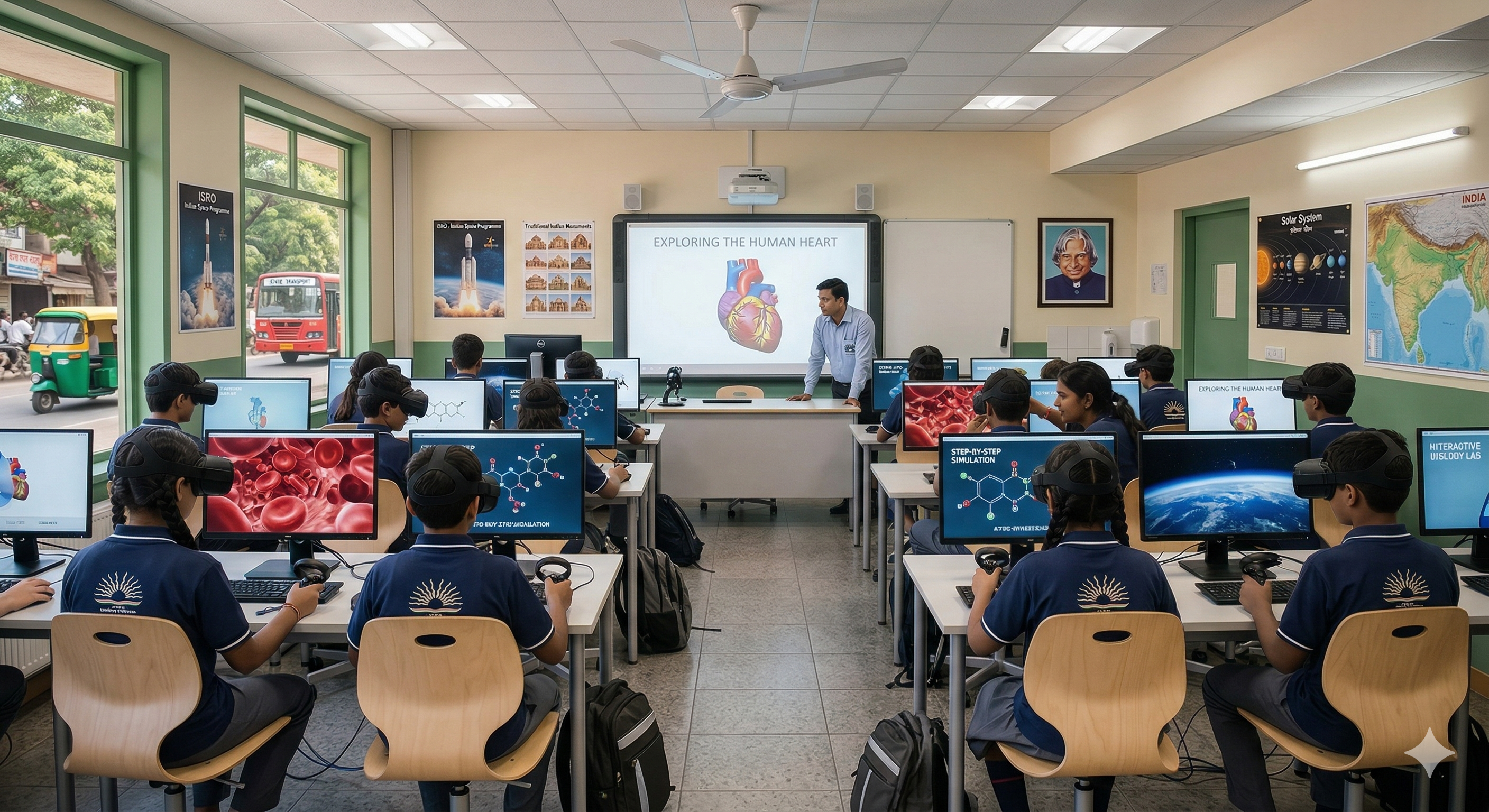
Your child's school has announced they are introducing VR labs. Your first reaction might be excitement — immersive learning sounds incredible. But then the doubts creep in. Is it safe for their eyes? Will they get motion sickness? Is it just more screen time? Could it be addictive?
These are legitimate concerns that every responsible parent should have. And they deserve honest, evidence-based answers — not marketing spin.
What the Research Actually Says
Let us start with what we know from peer-reviewed research and guidance from medical and regulatory bodies.
On eye health, the most common parental concern, the American Academy of Ophthalmology has stated that there is no evidence that VR headsets cause permanent eye damage in children. The concern about "screen proximity" (the display being close to the eyes) is addressed by the optical design of VR headsets — the lenses focus the display at a virtual distance of approximately 1.3 metres, so the eyes are not focusing on a close-up screen. That said, prolonged use can cause temporary eye strain, just as prolonged reading or screen use on any device can. The key is duration — short, structured sessions (15–20 minutes) show no adverse effects in studies.
On motion sickness, the research shows that VR-induced motion sickness (sometimes called "cybersickness") affects a small percentage of users — typically less than 5% in well-designed experiences. It is caused primarily by a mismatch between visual input (your eyes see movement) and vestibular input (your inner ear feels stillness). High-quality educational VR content, which typically involves stationary or slow-movement experiences, minimises this risk dramatically. Abhigyaan's content is specifically designed for seated or standing-stationary use, which virtually eliminates motion sickness triggers.
On age guidelines, Meta (manufacturer of Quest headsets) recommends their devices for users aged 10 and above. The underlying concern is that children below a certain age may find VR experiences confusing or overwhelming, not that the hardware is physically harmful. In educational contexts with teacher supervision, VR has been successfully used with children aged 8 and above without reported issues.
On screen time and addiction, this is the concern that deserves the most nuanced response. There is a growing body of research on screen time and children's health, but the critical insight is that not all screen time is equal. Passive consumption (scrolling social media, watching YouTube without purpose) has different effects from active, structured learning. A 20-minute teacher-led VR lab session is fundamentally different from 2 hours of unsupervised YouTube viewing. Educational VR is structured (it has a beginning, middle, and end), supervised (a teacher is present), curriculum-aligned (it has learning objectives), and time-limited (sessions are 15–20 minutes). There are no recommendation algorithms, no infinite scrolling, no microtransactions, and no social media dynamics.
Educational VR Is Not Gaming VR
This distinction is critical and often lost in the conversation.
When parents hear "VR," they might picture their child in a gaming headset for hours, playing violent or addictive games. Educational VR is a completely different experience.
In a school VR lab, the teacher controls what content is available — students cannot browse the internet or access non-educational apps. Sessions are time-limited and scheduled — typically 15–20 minutes per session, 2–3 sessions per week. The experience is guided — the teacher leads the class through an experiment step by step. Assessment follows — students complete quizzes and activities after the VR session, reinforcing learning. And the headsets stay at school — students do not take them home.
The Safety Advantage of VR Over Physical Labs
There is an irony in the safety conversation that is worth highlighting. Parents worried about VR safety should consider what VR replaces.
A traditional science lab involves concentrated acids, open flames, sharp glassware, electrical circuits, and biological specimens preserved in chemicals. These present real, physical safety hazards that cause real injuries every year in schools.
A VR lab involves none of these hazards. A student performing a virtual acid-base titration learns the same concepts and procedures as a student in a physical lab — but with zero risk of chemical burns, broken glass, or chemical exposure. In this sense, VR is significantly safer than the traditional alternative.
Best Practices for Schools and Parents
For schools, establish clear VR usage policies: maximum session duration (15–20 minutes), minimum break between sessions (15 minutes), hygiene protocols (cleaning headsets between users with disinfectant wipes), and supervision requirements (a trained teacher must be present for all sessions). Ensure headsets are properly adjusted for each student — the interpupillary distance (IPD) setting should be correct to avoid eye strain.
For parents, ask your school about their VR usage policies and session durations. Talk to your child about their VR experiences — what did they learn? What experiments did they do? If your child reports headaches, nausea, or discomfort during VR sessions, inform the teacher — these symptoms may indicate the headset needs adjustment or that the student needs shorter session durations. And if your child has a pre-existing vision condition (such as amblyopia or strabismus), consult your ophthalmologist before VR use.
VR in education is safe, effective, and well-studied. The key, as with any technology, is structured, supervised, age-appropriate use. And in the context of giving millions of Indian students access to lab experiences they would otherwise never have, the benefits far outweigh the minimal, manageable risks.