

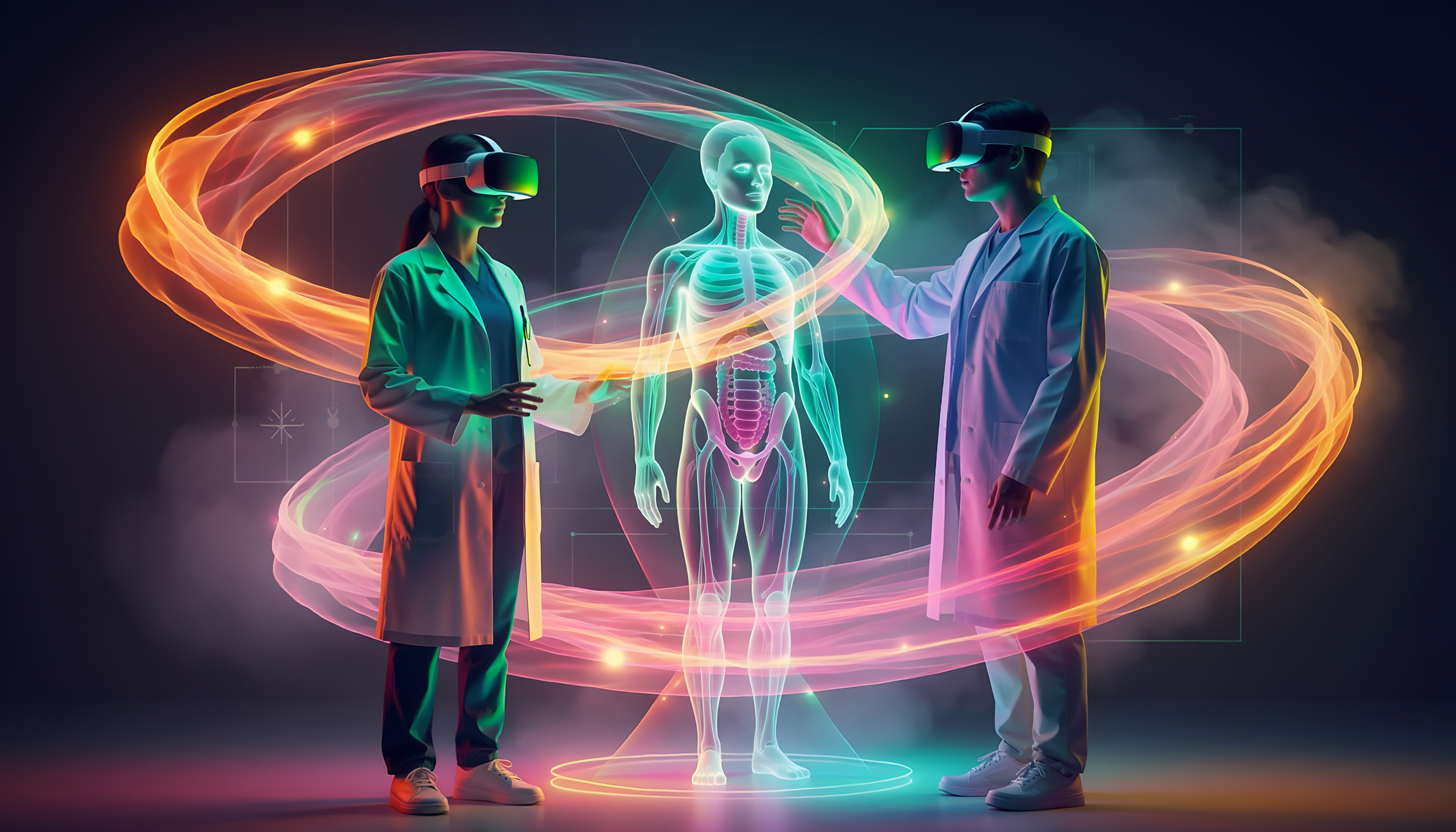
Your child comes home from school excited. "We did a VR experiment today!" they announce. "I went inside a human heart!" You smile, but you are also curious — and maybe a little uncertain. What exactly happened? What did they learn? And is this actually better than the science education you received?
This guide is for parents. It explains, in plain terms, what VR learning is, what a typical VR session looks like, what your child gains from it, and how you can support their learning at home.
What Is VR Learning?
At its simplest, VR learning is using a virtual reality headset to experience educational content in 3D. Instead of reading about the solar system in a textbook, your child stands in space and watches planets orbit around them. Instead of looking at a 2D diagram of a cell, they walk inside a 3D cell and examine each organelle up close. Instead of reading the procedure for a chemistry experiment, they actually perform the experiment — pouring chemicals, observing reactions, recording results — all in a safe, virtual environment.
Think of it as a science lab inside a headset. Except this lab has no chemicals that can spill, no glassware that can break, and no experiments that are too dangerous or expensive to attempt.
What a Typical VR Session Looks Like
Parents often imagine VR as an unstructured, unsupervised experience. In reality, a school VR session is as structured as any other lesson.
Before the session begins, the teacher selects the specific experiment or module from the Abhigyaan LMS. This is aligned to whatever topic the class is currently studying — it is not random exploration. The teacher prepares a brief introduction, explaining what students will experience and what they should pay attention to.
During the session, students put on their headsets and enter the virtual environment. The teacher guides them verbally through the experience while casting the VR view to a large smart TV so the entire class (and the teacher) can see what is happening. The session typically lasts 15–20 minutes. The teacher can pause, rewind, or highlight specific elements throughout the experience.
After the session, students remove their headsets and complete follow-up activities — usually an interactive quiz or a group discussion about what they observed. The teacher uses the Abhigyaan analytics dashboard to see how each student performed.
This is supervised, structured, curriculum-aligned instruction — enhanced by immersion.
What Your Child Actually Learns
The educational benefit of VR is not novelty — it is depth of understanding.
When your child reads that "the heart has four chambers," they are memorising a fact. When they step inside a virtual heart and watch blood flow from the right atrium through the tricuspid valve into the right ventricle, then travel through the pulmonary artery to the lungs, and return oxygenated through the pulmonary veins to the left atrium — they understand how the heart works. They can describe it, explain it, and apply that understanding to related questions about circulation, respiration, and cardiac health.
This is the difference between surface learning and deep learning. Research consistently shows that experiential, hands-on learning leads to significantly higher retention rates. Students who "do" an experiment — even virtually — retain far more than students who only read about it.
In practical terms, this means better performance on exams that test understanding, not just recall. Board exams increasingly include application-based questions that require students to explain processes, predict outcomes, and analyse data. Students with VR lab experience have a meaningful advantage on these questions.
How You Can Support VR Learning at Home
Even though VR headsets stay at school, you can support your child's VR learning from home.
Ask about their VR experiments. "What did you do in the VR lab today?" is a powerful question. When children explain what they learned to a parent, they reinforce their understanding through the act of teaching. Ask follow-up questions: "What happened when you mixed those two chemicals?" or "How does blood get from the heart to the lungs?" These conversations extend the learning beyond the classroom.
Use the Abhigyaan Web Player. Abhigyaan offers a web-based player that works on any laptop or tablet — no VR headset required. Your child can revisit the same experiments and modules they used in class, explore additional content, and use the AI Storyteller Teacher for doubt-clearing. Ask your school for login credentials if your child does not already have them.
Connect VR learning to the real world. If your child learned about plant cells in VR, point out plants in your garden and discuss what is happening inside their cells. If they performed a virtual chemistry experiment, look up the real reaction on YouTube and compare what they observed. Making these connections reinforces that VR content represents real science, not just a game.
Review their progress. Ask your child to show you their quiz results and progress on the Abhigyaan platform. Celebrate improvements. Identify areas where they need additional practice. Being engaged with their learning platform — the same way you would review their homework notebook — signals that you take their VR education seriously.
The Bigger Picture
Your generation learned science from textbooks and blackboards. Your children are learning science by doing it — virtually. They are building circuits, mixing chemicals, dissecting specimens, and walking through human organs. They are developing spatial reasoning, procedural understanding, and scientific curiosity in ways that were simply not possible before.
This is not a replacement for good teaching — it is an amplification of it. The teacher is still there, guiding, explaining, inspiring. The VR lab is a tool that gives that teacher superpowers: the ability to show students the inside of a cell, to let them perform experiments that no physical lab could safely allow, and to make abstract concepts tangible and unforgettable.
Your child is not just learning about science. They are experiencing it. And that makes all the difference.