

India is home to approximately 1.5 million schools educating over 250 million students. It is the largest school education system in the world after China. Yet a staggering fact undermines the entire system: fewer than 2% of these schools have a functioning science laboratory.
This is not a minor gap. It is a structural failure that affects every student who passes through the Indian education system without ever performing a real experiment. And it explains, more than any other single factor, why India's students struggle with applied knowledge and critical thinking when benchmarked against global peers.
What "No Lab" Actually Looks Like
In urban, private schools, this statistic might seem abstract. But visit a Zilla Parishad school in rural Maharashtra, or a government school in Uttar Pradesh, and the reality is stark.
Science is taught entirely from a textbook. The teacher reads aloud. Students copy notes. Diagrams are drawn on a blackboard — a flat, 2D representation of inherently 3D phenomena. Chemical reactions are described in words that students memorise without ever witnessing the reaction. Biology is reduced to labelled diagrams that students reproduce from memory in exams. Physics experiments are "studied" by reading procedures and writing expected results without ever touching any apparatus.
Students learn that the chemical formula for sulphuric acid is H₂SO₄. They learn that it is a strong acid. They can write balanced equations involving it. But they have never seen it. Never smelled it. Never watched it react with a base and observed the colour change of an indicator. Their understanding is entirely abstract, entirely textual, and entirely fragile.
Why Labs Do Not Exist
The reasons are practical and systemic.
The cost barrier is the most obvious. A basic science lab requires a dedicated room (which many schools do not have), laboratory furniture, equipment, chemicals, specimens, safety infrastructure, and a trained lab attendant. The setup cost runs between ₹5–15 lakh, with recurring annual costs of ₹2–5 lakh for consumables, maintenance, and personnel. For government schools operating on per-student budgets measured in the low hundreds of rupees per month, this is simply impossible.
The infrastructure barrier is equally significant. A proper chemistry lab requires plumbing (running water and drainage), electrical connections, ventilation (fume hoods), chemical storage (locked, ventilated cabinets), and fire safety equipment. Many rural schools operate in buildings that lack reliable electricity, let alone the infrastructure required for a functional laboratory.
The personnel barrier compounds the problem. A science lab requires a trained lab attendant to maintain equipment, prepare experiments, manage chemical inventory, and ensure safety compliance. Finding and funding such personnel in rural areas is extremely difficult.
The safety and liability barrier adds another layer. Schools are understandably reluctant to allow children to handle concentrated acids, open flames, and sharp glassware without proper supervision and safety infrastructure. The potential for accidents, and the legal liability they create, is a real deterrent.
The Consequence for Students
The impact on learning outcomes is profound and well-documented.
Students who learn science without practical experience develop what educators call "surface knowledge" — they can recall facts and formulas but cannot apply them to real situations. They can describe an experiment's procedure in an exam but cannot troubleshoot when something goes wrong. They can label a diagram of the heart but have no spatial understanding of how blood actually flows through it.
This matters beyond exam performance. India produces millions of graduates who have "studied" science for a decade but have never actually done science. They enter engineering, medicine, and research with theoretical knowledge but limited practical competence. The consequences ripple through the economy and the quality of India's scientific and technical workforce.
The NEP 2020 Mandate — Without a Funding Path
NEP 2020 explicitly mandates experiential, hands-on learning. The policy recognises that rote memorisation must give way to practical application. But the policy's vision collides with fiscal reality: there is no clear funding mechanism to build physical labs in 1.5 million schools. Even if the funding existed, the construction timeline would span decades.
This is where virtual labs become not just an option, but the only scalable solution.
Virtual Labs as the Answer
Abhigyaan's deployment in 1,360 government schools across Kolhapur and Baramati, Maharashtra provides a proof of concept at meaningful scale.
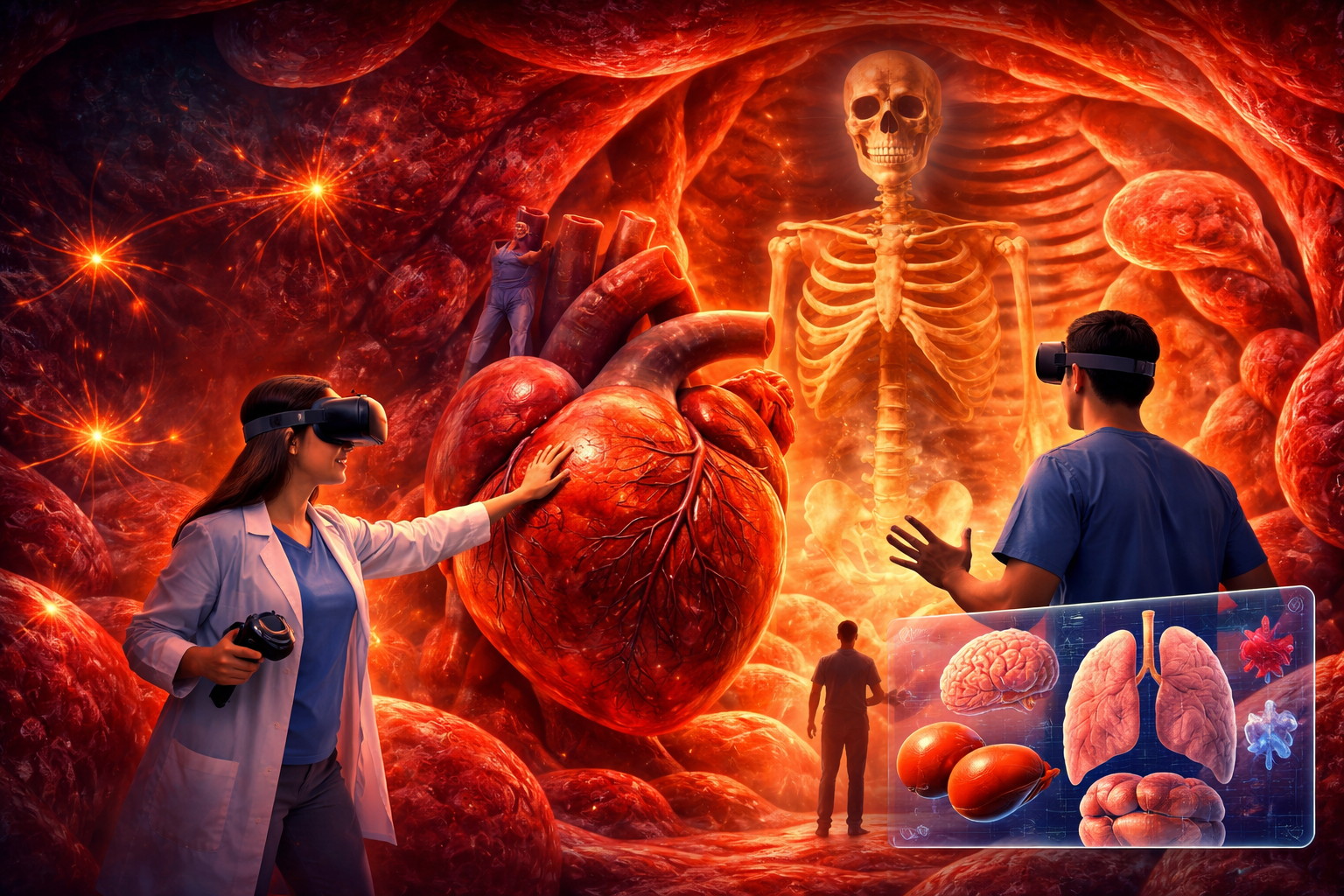
These are Zilla Parishad schools — government-run, rural, limited-infrastructure. Many had never had any form of science lab. Within a 60-day deployment cycle, each school received a VR lab (8 Meta Quest headsets, PC, smart TV), teacher training, and access to 250+ curriculum-aligned experiments.
The cost per school is a fraction of a physical lab. The recurring per-student cost of ₹199/month makes it sustainable within existing school budgets. Content covers Physics, Chemistry, and Biology for CBSE, NCERT, and state boards. And critically, the content is available in regional languages — Marathi and Hindi — ensuring that rural students can learn in their medium of instruction.
There are no chemicals to replenish. No glassware to replace. No safety incidents to manage. No lab attendant to hire. And every experiment can be repeated unlimited times at zero marginal cost.
What Needs to Happen
Solving the science lab crisis requires action on multiple fronts. Policymakers should recognise virtual labs as legitimate NEP 2020 compliance tools and fund them accordingly through Samagra Shiksha Abhiyan and state education budgets. School administrators should stop waiting for physical lab funding that may never arrive and start with VR-based alternatives that can be deployed in weeks, not years. CSR partners should fund VR labs as high-visibility, high-impact education projects — each lab serves hundreds of students per year. Parents and communities should demand lab access for their children and advocate for technology adoption in their local schools.
The science lab crisis is not inevitable. It is solvable, with technology that exists today, at a cost that is affordable today, with evidence of impact that is available today. The only question is how long we will wait before acting.