

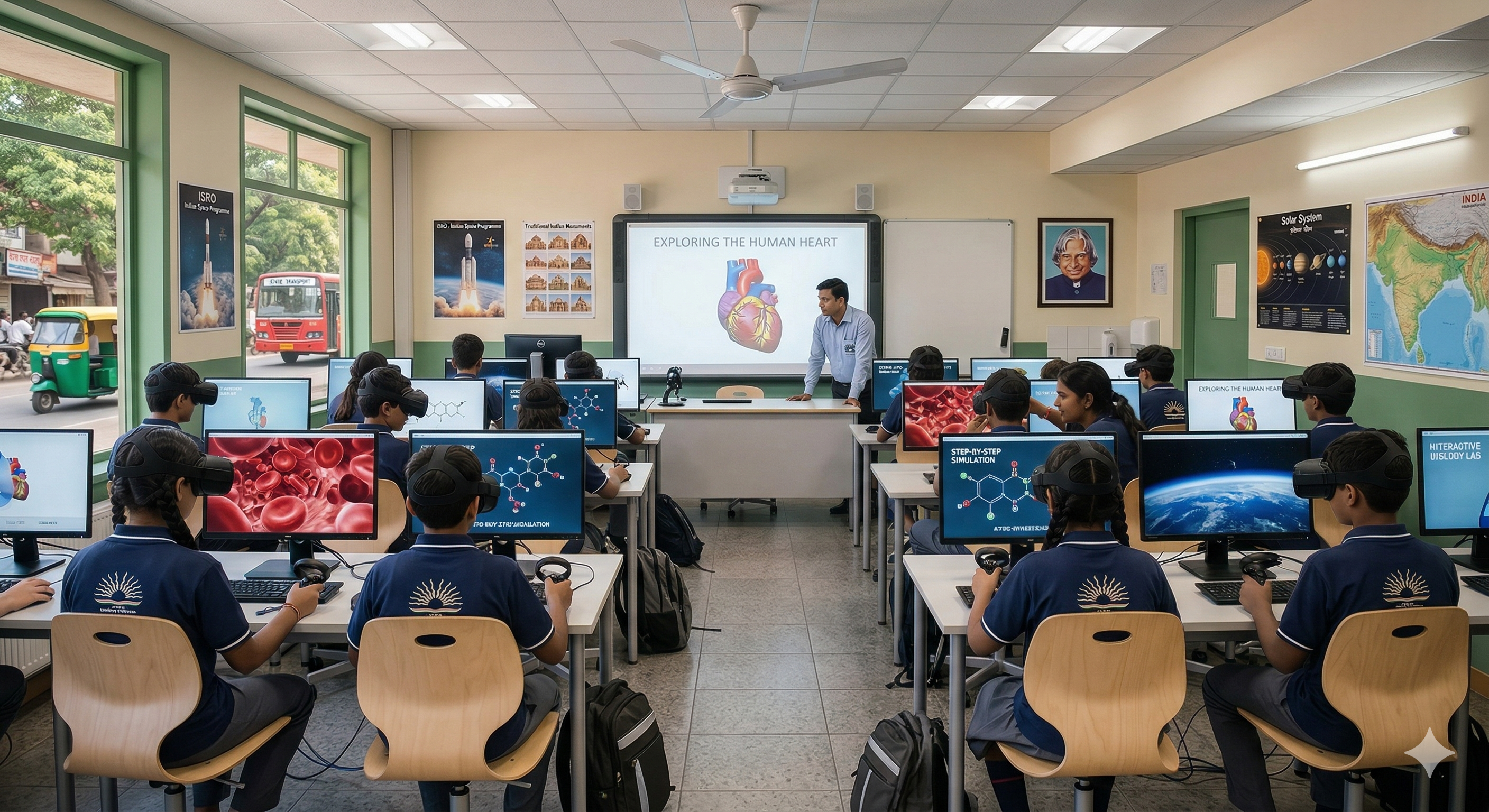
Every time a new AI product is announced, the same headline appears: "Will AI replace teachers?" It is a question driven by genuine anxiety — teachers are among the most important professionals in any society, and the idea that they could be made redundant by software is alarming.
We build AI teaching tools. Abhigyaan's platform includes a generative AI tutor (the AI Storyteller Teacher) that explains concepts to students through narrative, adapts to their learning pace, and operates in multiple Indian languages. So we are often asked this question directly.
Here is our honest answer: No. AI will not replace teachers. But it will fundamentally change what teaching looks like — and teachers who learn to work with AI will be far more effective than those who ignore it.
What AI Does Exceptionally Well
Let us be specific about what AI can do in an educational setting, because precision matters in this conversation.
AI excels at content delivery at scale. A single AI system can explain a concept to a million students simultaneously, each in their preferred language, at their preferred pace. It never gets tired, never loses patience, never has a bad day. For repetitive explanation — the kind of teaching where a student needs to hear the same concept explained five different ways before it clicks — AI is objectively superior to any single human teacher.
AI is also excellent at generating practice material. It can create unlimited variations of quiz questions at the right difficulty level for each student. It can provide instant feedback — not "your answer is wrong," but "your answer is wrong because you confused velocity with acceleration; here is the difference." It can track patterns across thousands of quiz responses and identify common misconceptions that even experienced teachers might miss.
AI is outstanding at data analysis and pattern recognition. An AI-powered LMS can track every student's engagement, performance, and learning trajectory. It can flag students who are falling behind before they fail a test. It can identify which concepts are causing the most confusion across an entire school and alert teachers to adjust their instruction accordingly.
What AI Cannot Do
Now here is the other side, and this is where the replacement narrative falls apart.
AI cannot build relationships. A significant body of educational research shows that the quality of the teacher-student relationship is one of the strongest predictors of student success. Students who feel known, valued, and cared for by their teacher perform better academically and are more likely to stay in school. AI cannot know a student. It cannot notice that Priya has been unusually quiet this week. It cannot pull Rahul aside after class and ask if everything is okay at home.
AI cannot manage a classroom. Teaching a room of thirty children requires real-time judgment, emotional intelligence, conflict resolution, and physical presence. It requires noticing that two students in the back are not paying attention, redirecting the class after a fire drill disrupts the routine, and adjusting the lesson plan because a conversation about yesterday's cricket match has energised the room in a way that can be channelled into a physics discussion about projectile motion.
AI cannot inspire. The teacher who made you fall in love with a subject — the one who told a personal story about why they chose science, who stayed after school to help you with a project, who believed in you when you did not believe in yourself — that teacher is irreplaceable. Motivation, mentorship, and human inspiration operate on a level that AI does not access.
AI cannot model values. Education is not just about content knowledge. It is about learning to think critically, to debate respectfully, to collaborate, to handle failure, to be curious. These are learned through human interaction, not algorithmic instruction.
The Real Shift: From Content Delivery to Learning Design
The correct framing is not "replacement" but "role transformation."
For decades, teachers have been primarily content delivery agents. They stand in front of a class and explain concepts — a role that was necessary when the teacher was the only source of organised information available to students. But in a world where AI can handle content delivery better, faster, and more personalised than any individual human, the teacher's most valuable contribution shifts.
Teachers become learning designers: curating experiences, designing projects, creating contexts where students can apply knowledge. They become mentors: providing the emotional support, motivation, and guidance that keeps students engaged. They become facilitators: managing collaborative work, guiding discussions, and helping students learn from each other. They become assessors of the things AI cannot assess: creativity, collaboration, ethical reasoning, and practical application.
This is not a demotion. It is an elevation. The most rewarding, most impactful parts of teaching — the parts that made people become teachers in the first place — are precisely the parts that AI cannot touch.
What Teachers Should Do Right Now
For teachers reading this, here is practical advice.
Learn to use LMS platforms and analytics dashboards. Understanding student data will make you a more effective teacher. When you can see, at a glance, which students are struggling with which concepts, you can intervene earlier and more precisely. Abhigyaan's teacher dashboard is designed for this — it does not require technical expertise, just willingness to engage.
Embrace AI as your teaching assistant. Let the AI handle the repetitive explanation. Let it generate quiz questions. Let it provide after-hours doubt-clearing. This frees your time for the work that only you can do.
Focus on what makes you irreplaceable. If your only skill is explaining textbook content, then yes, you will feel threatened by AI. But if you invest in your relationship-building, your classroom management, your mentorship, and your ability to inspire — you will not just survive the AI era, you will thrive in it.
The future of education is not AI vs. teachers. It is AI and teachers, working together, each doing what they do best. And the students are the ones who benefit.