

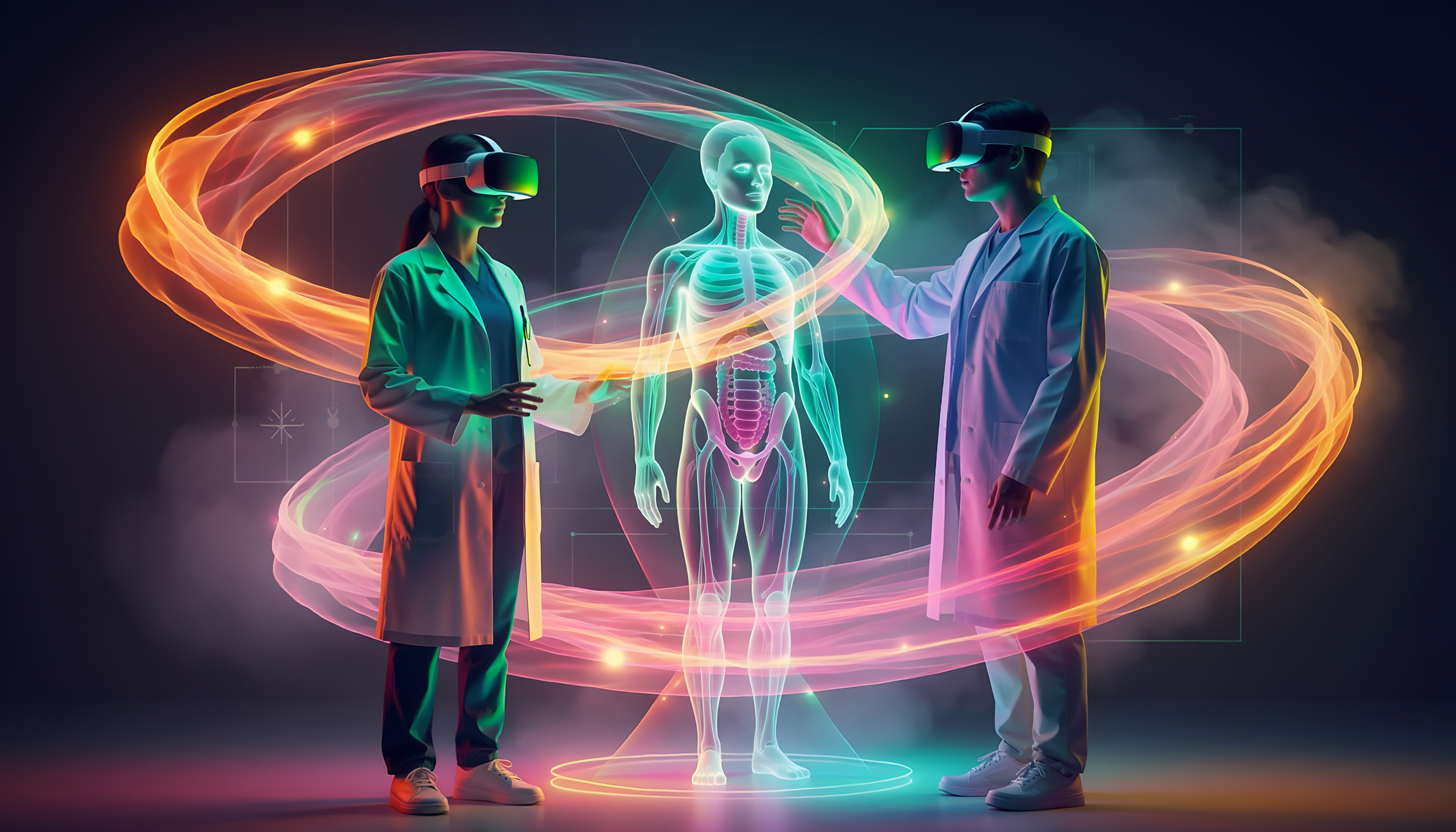
Medical education has a fundamental paradox. Students must learn to perform complex procedures on human bodies, but they cannot practise freely on real patients. The traditional solution — cadaver dissection, clinical observation, and supervised practice — has served medicine for centuries, but it has always been limited by availability, ethics, and cost.
Virtual reality is resolving this paradox. Medical students can now step inside a human heart, rotate a liver in 3D, trace the path of a nerve from the spine to the fingertips, and practise surgical procedures in a risk-free virtual environment. The implications for medical education are as profound as the introduction of anaesthesia was for surgery itself.
The Limitations of Traditional Medical Training
Traditional medical training faces several structural constraints that VR can address.
Cadaver availability is declining globally. The number of bodies donated to medical education has not kept pace with the growing number of medical students. In India, cadaver shortages are particularly acute, with many medical colleges sharing limited specimens across large student cohorts. This means that individual students often have minimal hands-on dissection time — sometimes observing from a distance rather than performing the dissection themselves.
Ethical constraints are inherent. There are procedures that students cannot practise on living patients until they have demonstrated competence — but they cannot demonstrate competence without practice. This creates a training gap that is typically bridged by observation and hope.
Repetition is limited. In a cadaver lab, once a structure is dissected, it cannot be undissected. A student who makes an error cannot reset and try again. In surgery, a trainee gets one chance to perform each step correctly, under the stress of a real operating room.
And the cost of simulation alternatives is prohibitive. High-fidelity surgical simulators cost lakhs or crores of rupees, making them accessible only to the best-funded institutions.
What VR Medical Training Looks Like
Modern VR medical training goes far beyond watching a 3D video. It is interactive, explorative, and increasingly haptic (incorporating the sense of touch).
In anatomy education, students can enter a virtual body and explore organs at any scale. They can shrink themselves to the size of a red blood cell and travel through the circulatory system. They can peel back layers of tissue to expose underlying structures. They can rotate, zoom, and isolate any organ or system. And they can do this repeatedly, from any angle, at their own pace.
In surgical training, VR simulations allow students to practise procedures step-by-step. A cholecystectomy (gallbladder removal), for example, can be practised dozens of times in VR before a student ever enters a real operating room. The VR system can track instrument movements, assess precision, measure time, and provide objective performance scores.
In clinical scenario training, VR environments can simulate emergency department situations, where students must triage patients, make rapid diagnostic decisions, and initiate treatment — all under simulated time pressure and stress.
The Evidence Base
The research supporting VR in medical education is extensive and growing.
A landmark study published in the Journal of the American Medical Association (JAMA) found that VR-trained surgeons performed with significantly fewer errors and were substantially faster at completing procedures compared to traditionally trained peers. A meta-analysis in the journal Advances in Health Sciences Education found consistent improvements in both knowledge acquisition and skill performance when VR was used as a supplement to traditional medical training.
The key finding across studies is not that VR should replace cadavers or clinical experience. It is that VR provides a critical additional training layer — one that allows for repetition, self-paced learning, and skill development before real-world clinical contact.
Abhigyaan's Healthcare Training Module
Abhigyaan, in partnership with Armed Forces Medical College (AFMC), Pune, is developing VR-based medical training modules designed specifically for the Indian medical education context.
The current focus areas include organ inspection modules where medical students can explore organ anatomy in 3D with labelling, layered views, and pathological comparisons. Surgical procedure training offers step-by-step procedural walkthroughs with emphasis on hepatobiliary surgery (liver, gallbladder, bile duct, pancreas). The modules are designed to align with the National Medical Commission's Competency-Based Medical Education (CBME) framework.
AFMC is one of India's most prestigious medical institutions, and the partnership ensures that Abhigyaan's medical modules are developed with clinical accuracy and pedagogical rigor. The modules are not generic 3D models — they are designed by medical educators to address specific competency requirements in the Indian medical curriculum.
CBME Alignment — Why This Matters
The National Medical Commission (NMC) has mandated Competency-Based Medical Education across all medical colleges in India. CBME requires that students demonstrate practical competence in specific skills — not just theoretical knowledge.
This creates a significant assessment challenge. How do you objectively assess whether a medical student is competent in a surgical skill before they perform it on a patient? Written exams cannot test procedural competence. Observed clinical assessments are subjective and limited by opportunity.
VR simulation provides an elegant solution. A VR surgical simulation can objectively measure a student's instrument handling, procedural accuracy, time to completion, error rate, and decision-making under pressure. These metrics can be standardised across institutions, creating a fair and reproducible competency assessment framework.
For medical college administrators, the recommendation is clear: begin integrating VR simulation into your CBME assessment toolkit. Start with anatomy and basic surgical skills, where the VR technology is most mature and the evidence base is strongest. Partner with platforms like Abhigyaan that are building India-specific, CBME-aligned content.
The future of medical training is not either traditional or virtual. It is both — with VR providing the safe, repeatable, objective practice environment that bridges the gap between textbook knowledge and clinical competence.