

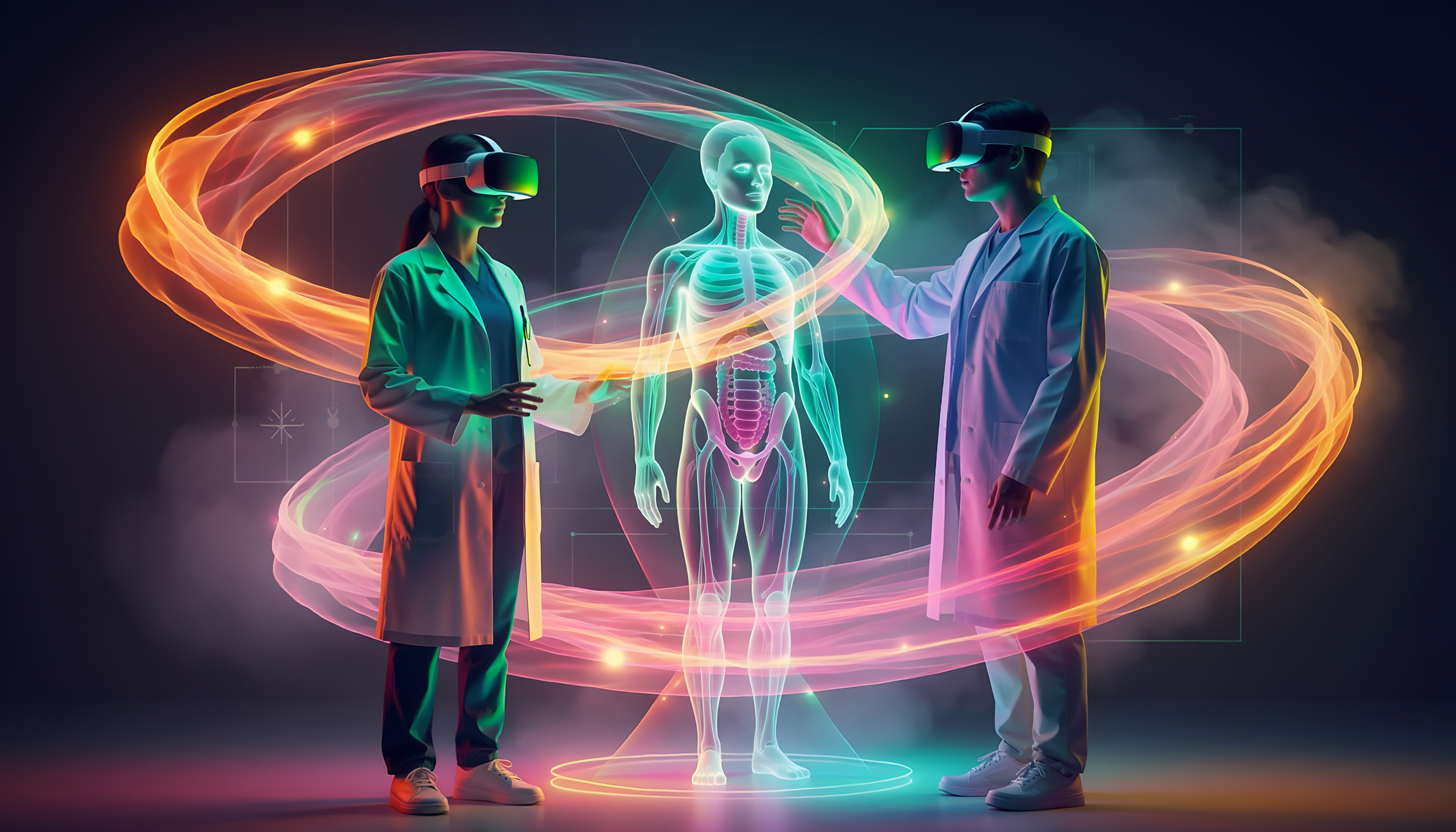
Picture a Class 8 student in a small government school in rural Kolhapur. She has never seen a functioning science lab. The closest she has come to understanding the human circulatory system is a faded diagram in her NCERT textbook. Now, picture her putting on a VR headset and stepping inside a beating human heart — watching blood flow through chambers, seeing valves open and close, hearing her teacher explain each part as she looks around in 360 degrees.
This is not a futuristic fantasy. This is happening right now in over 1,360 government schools across Maharashtra.
Virtual reality in education is not a gimmick. It is the single most transformative shift in how children learn since the internet first connected classrooms to the world. And for a country like India — where 98% of schools have no functioning science lab — VR is not just an upgrade. It is the only realistic path to giving every student a quality, hands-on education.
The Problem with Passive Learning
For decades, Indian education has relied on a model that prioritises rote memorisation over genuine understanding. Students read about chemical reactions but never see one. They memorise the parts of a cell but never interact with a 3D model. They learn Newton's Laws from a blackboard, never from experimentation.
The data reflects this. The widely referenced "Learning Pyramid" model, based on research from the National Training Laboratories, suggests that students retain approximately 10% of what they read, 20% of what they hear in a lecture, and up to 75% of what they learn through hands-on practice. Indian classrooms operate almost entirely in the 10–20% zone.
India's PISA (Programme for International Student Assessment) performance has reflected this gap. When students are assessed on their ability to apply knowledge — not merely recall it — the results are sobering. The root cause is not a lack of intelligence or effort. It is a lack of infrastructure that allows students to actually do science rather than just read about it.
What VR Actually Looks Like in a Real Classroom
There is a common misconception that VR in education means handing children expensive headsets and leaving them to wander virtual worlds unsupervised. The reality is far more structured and far more effective.
In an Abhigyaan VR lab, a typical session looks like this: the school has a dedicated room with 8 Meta Quest VR headsets, a high-performance PC, and a 55-inch smart TV for casting. The teacher selects an experiment aligned to the day's lesson plan — say, an acid-base titration for Class 10 Chemistry. The teacher initiates the session from the Abhigyaan LMS dashboard, and all headsets sync to the same experiment. The teacher narrates and guides from the front of the room while the smart TV mirrors what students see inside their headsets.
The session lasts 15–20 minutes. Students interact with the experiment by performing each step: selecting chemicals, pouring solutions, observing colour changes, and recording observations. The teacher controls the pace, pauses for explanation, and asks questions. After the VR session, students complete an interactive quiz on the same topic within the LMS.
This is not isolated, unguided play. It is structured, curriculum-aligned, teacher-led pedagogy — enhanced by immersion.
The Evidence Is Overwhelming
The argument for VR in education is not based on hype. It is based on research conducted over the past decade by some of the world's most respected institutions.
A landmark study by PwC found that VR learners completed training four times faster than classroom learners and were 275% more confident in applying what they learned. Stanford University's Virtual Human Interaction Lab (VHIL) has published extensive research showing that immersive experiences create stronger emotional connections to content, leading to deeper understanding and longer retention.
In Abhigyaan's own deployment across 1,360 government schools in Maharashtra, the data tells a compelling story. Student engagement metrics — measured by session completion rates, quiz participation, and voluntary repeat usage — are significantly higher for VR-based sessions compared to traditional classroom instruction in the same schools.
Affordability Is No Longer an Excuse
The most common objection from school administrators and policymakers is cost. "VR is expensive" has been the default response for years. But the numbers tell a different story.
Building a traditional science lab in an Indian school costs between ₹5–15 lakh for setup alone, with recurring annual costs for chemicals, equipment replacement, and maintenance. Many schools simply cannot afford this, which is exactly why 98% of them operate without a lab.
An Abhigyaan VR lab costs a fraction of that amount. The per-student cost works out to approximately ₹199 per month — less than the cost of a single textbook. For that price, students get access to 250+ virtual experiments across Physics, Chemistry, and Biology, an AI-powered tutor, and a full Learning Management System with analytics.
When you compare the cost per experiment, the math is unambiguous. A physical chemistry experiment requires consumable chemicals every time it is performed. A VR experiment can be performed a thousand times at zero marginal cost.
What Schools Should Do Right Now
If you are a school administrator, principal, or education officer reading this, the path forward is straightforward.
Start small. You do not need to overhaul your entire school. Begin with one VR lab — one room, 8 headsets, one smart TV. Pilot it with your Science department for Classes 8–10, where the impact on board exam preparation is highest. Measure the results after one term: compare test scores, student engagement, and teacher feedback between VR-assisted and traditional classes.
The results will speak for themselves.
Abhigyaan is already live in 1,360 government schools, serving over 50,000 students. The platform supports CBSE, NCERT, ICSE, and state board curricula. Content is available in English, Hindi, Marathi, and Arabic. And the system works on Meta Quest, AjnaLens, JioGlass, and even as a web player on laptops and smart boards for schools that cannot yet afford VR hardware.
The question is no longer whether VR belongs in education. The question is how quickly your school will adopt it.