

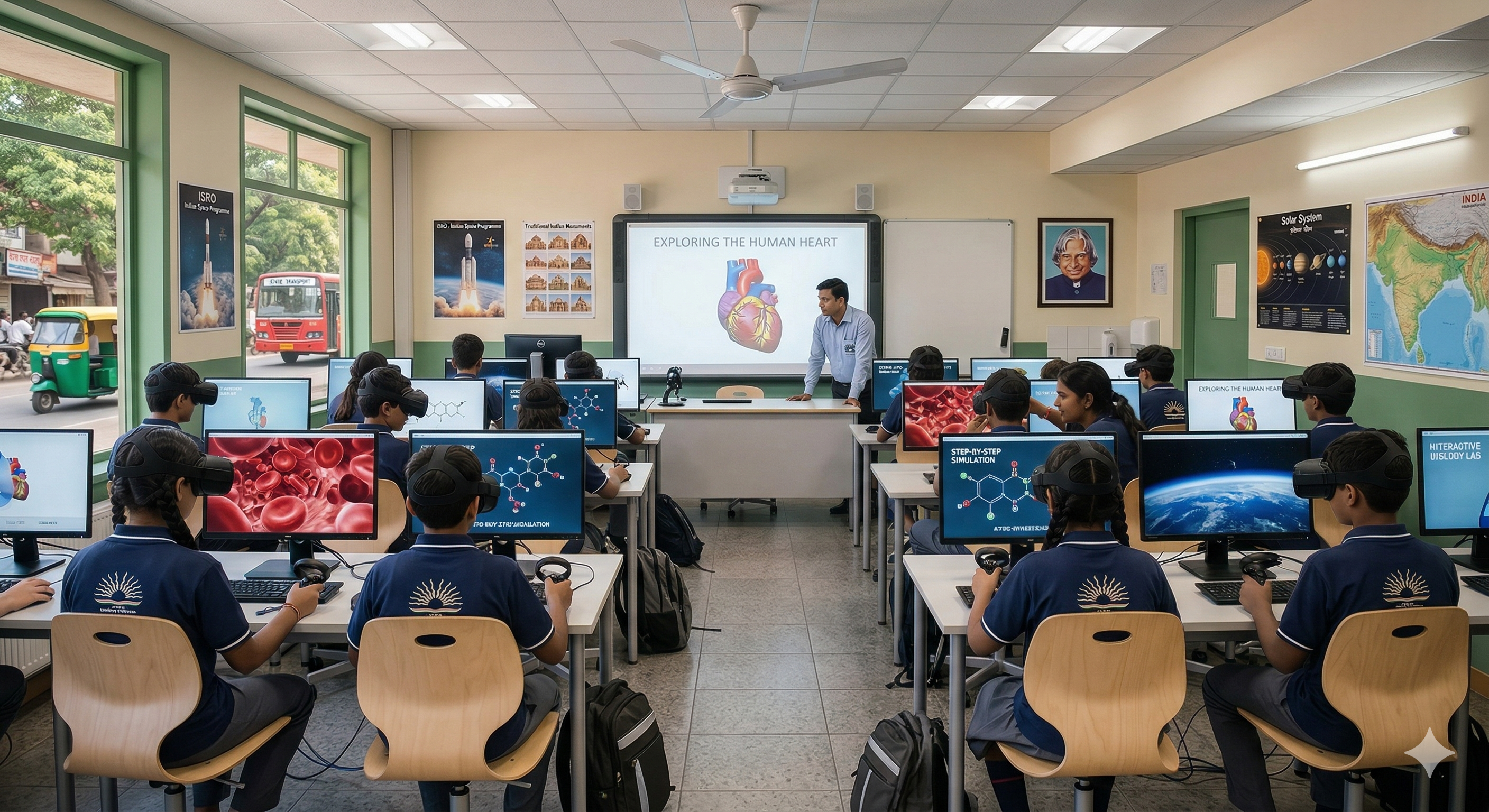
Every year, schools across India spend significant amounts on educational technology that never delivers its promised results. Smart boards that serve as glorified projectors. Computer labs that are used once a week for typing practice. VR headsets that are locked in a cabinet after the initial excitement fades. LMS platforms with single-digit adoption rates among teachers.
The technology itself is usually not the problem. The implementation is. And the same mistakes appear with remarkable consistency across schools of all types — government and private, urban and rural, well-funded and budget-constrained.
Here are the five most common mistakes, and how to avoid each one.
Mistake 1: Buying Hardware Without a Content Strategy
This is the single most common and most expensive mistake in school EdTech adoption.
The scenario is familiar. A school purchases VR headsets because "VR is the future." The headsets arrive. Teachers and students try them. There is initial excitement. But then the question arises: what content do we use? The school discovers that the headsets came without curriculum-aligned educational content. The generic VR apps available are entertainment-oriented, not education-oriented. And nobody planned for ongoing content investment.
Within a few months, the headsets sit in a cabinet, brought out occasionally for "special occasions" but never integrated into regular teaching.
The solution is simple but non-negotiable: choose your content platform first, then buy the hardware it requires. Abhigyaan's model bundles hardware, content, LMS, and training into a single deployment because hardware without content is useless, and content without a delivery system is inaccessible.
When evaluating any EdTech investment, ask this question first: "What specific curriculum-aligned content will my students use, and how will it integrate with their daily learning?" If the vendor cannot answer this clearly, walk away.
Mistake 2: Choosing Technology Before Defining Goals
"We need an LMS" is not a goal. "We need to improve our Class 10 science board exam pass rate by 15% within two academic years" is a goal. The distinction matters enormously because it determines what technology you buy, how you deploy it, and how you measure success.
When schools choose technology based on features rather than outcomes, they end up with platforms that have impressive feature lists but no clear connection to the school's actual priorities. They cannot measure ROI because they never defined what "return" means.
Before any technology decision, define your top three educational goals. Common examples include improving exam performance in specific subjects, increasing student engagement and attendance, achieving NEP 2020 compliance for experiential learning, or providing lab access for students who currently have none. Then evaluate technology specifically against those goals. Does the platform address your specific goals? Can you measure progress toward those goals using the platform's analytics?
Mistake 3: Skipping Teacher Training
If there is one lesson that every successful EdTech deployment reinforces, it is this: teacher training is not optional. It is the single most important factor in whether technology adoption succeeds or fails.
Technology deployed without teacher training follows a predictable trajectory. Initial excitement is followed by frustration as teachers struggle with unfamiliar interfaces. Frustration leads to avoidance. Avoidance leads to abandonment. And the school concludes that "technology doesn't work for us" — when the actual failure was in implementation, not technology.
Effective teacher training requires hands-on practice with the actual equipment teachers will use daily, not PowerPoint presentations about the technology. It requires adequate duration — a minimum of two days for initial training, with follow-up sessions at 30 and 60 days. It requires ongoing support through a helpdesk, champion teachers, and refresher training. And it requires addressing anxiety, because many teachers are genuinely nervous about technology and need a safe environment to make mistakes and build confidence.
Budget for training as a non-negotiable line item, equal in importance to the hardware budget. A school with well-trained teachers and modest technology will outperform a school with cutting-edge technology and untrained teachers, every time.
Mistake 4: Not Measuring Outcomes
You cannot improve what you do not measure. Yet many schools deploy technology without establishing any baseline metrics, any measurement framework, or any review cadence.
The result is that after a year of use, the school cannot answer basic questions: Has technology improved student performance? Are teachers using the platform regularly? Which students are benefiting most? Which are being left behind?
Before deployment, establish baseline measurements for the metrics you care about — exam scores, attendance, engagement, teacher satisfaction. After deployment, review these metrics quarterly. Use the LMS analytics dashboard to track student and teacher activity in real time.
This data serves two purposes. First, it tells you whether the technology is working and where adjustments are needed. Second, it gives you the evidence to justify continued investment (or to change course if results are not materialising).
Mistake 5: Trying to Do Everything at Once
Ambition is admirable. But attempting a full-school digital transformation in a single step is a recipe for chaos, teacher burnout, and failure.
Start small. One VR lab. One subject (Science). One grade range (Classes 8–10). One term of measurement. Prove the concept at a manageable scale. Build teacher confidence and competence. Generate data. Then expand deliberately — to additional subjects, additional grades, additional classrooms — based on evidence and demonstrated capacity.
This phased approach has additional benefits: it manages budget by spreading investment over time, it builds internal champions who advocate for expansion, and it creates a body of evidence that makes each subsequent expansion easier to approve.
How Abhigyaan Addresses All Five
Abhigyaan's deployment model is designed specifically to avoid these five mistakes. The platform bundles hardware, content, LMS, and training into a single deployment — eliminating Mistake 1. The deployment process begins with goal definition and success metrics — addressing Mistake 2. Teacher training is a mandatory, hands-on, 2-day programme included in every deployment — preventing Mistake 3. The analytics dashboard provides real-time measurement of student and teacher engagement — solving Mistake 4. And the standard deployment starts with a single VR lab for Science, with expansion driven by data — following the phased approach that avoids Mistake 5.
EdTech adoption is not inherently risky. It is risky when the implementation is careless. With the right approach — goals first, training always, measurement everywhere, and patience in scaling — the results are consistently positive.