

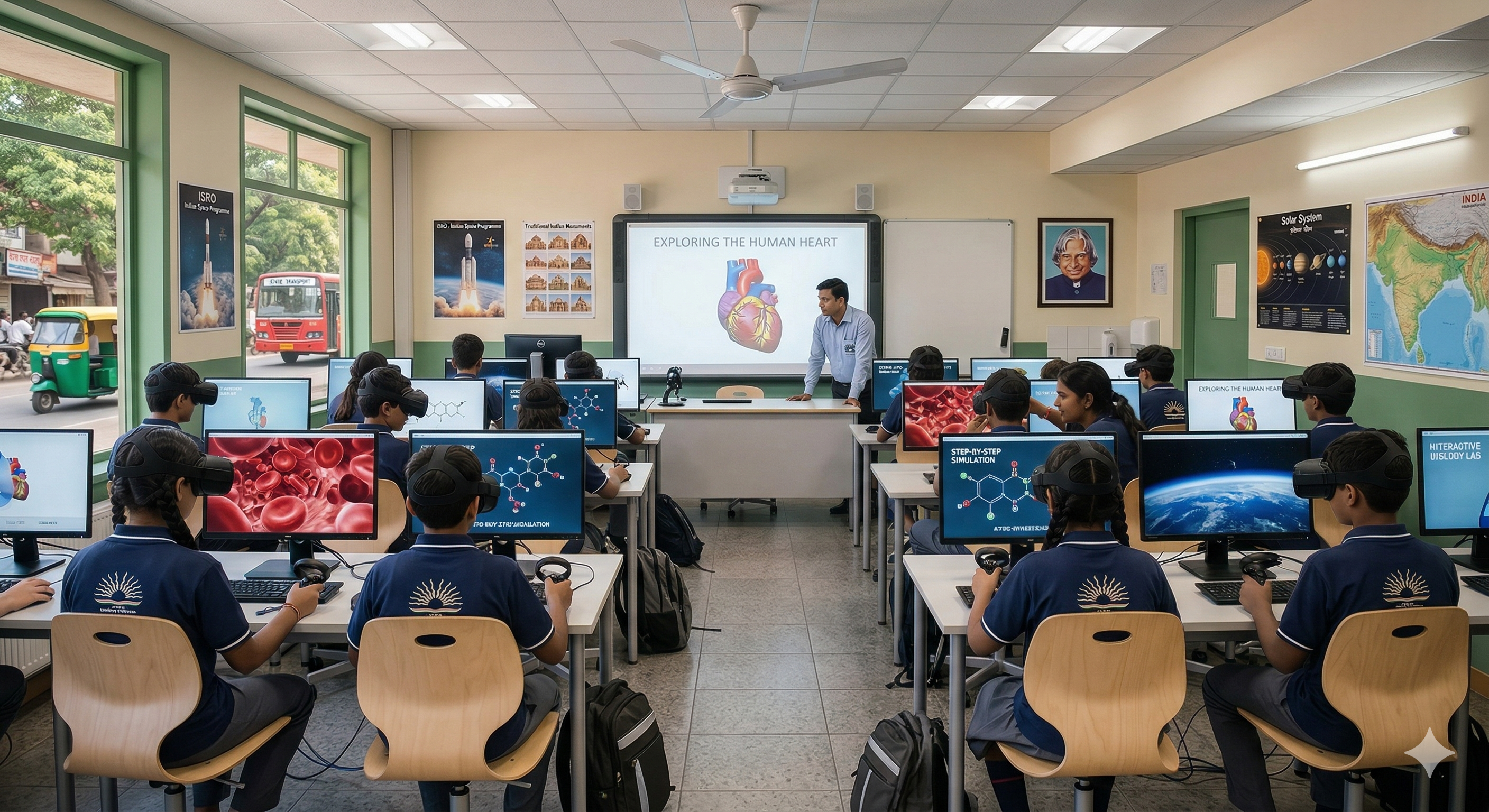
Choosing the right VR headset for your school is a consequential decision. The hardware you select determines your budget, your content options, your teacher workflow, and your students' experience. Get it right, and you have a powerful learning tool for years to come. Get it wrong, and you have expensive doorstops.
This guide compares the major VR headset options available for educational use in India in 2026, evaluated on the criteria that actually matter for schools: cost, durability, content compatibility, ease of use, and classroom manageability.
Meta Quest 2 & 3
Meta's Quest line is the most widely adopted VR platform in education globally, and for good reason.
The Meta Quest 2 offers a fully standalone headset with no external PC or wires required. It features high-resolution displays (1832 x 1920 per eye for Quest 2, higher for Quest 3), inside-out tracking (no external sensors needed), built-in audio, hand tracking support, and a broad content ecosystem. The price point has come down significantly, making it affordable for school deployments. Quest 3 adds mixed reality (passthrough cameras that blend real and virtual), a more powerful processor, and improved optics.
For education specifically, the Quest line offers the largest library of educational VR content. Abhigyaan's full platform runs on Quest 2 and 3. Device management tools exist for deploying and managing multiple headsets at once. Battery life is approximately 2–3 hours of active use, sufficient for a full school day of rotated sessions.
The main considerations for schools are that the Quest requires a Meta account for setup, which should be a school-managed institutional account rather than personal accounts. Regular firmware updates require periodic internet connectivity.
Our recommendation: Meta Quest is the best all-round choice for most K–12 schools. The combination of price, content library, ease of use, and standalone capability makes it the default recommendation.
AjnaLens
AjnaLens is an Indian-made mixed reality headset developed by Dimension NXG, a Mumbai-based company. It is notable for being the Government of India's preferred AR/VR hardware vendor for several defence and education programmes.
AjnaLens offers rugged, enterprise-grade build quality designed for institutional use, mixed reality (overlaying digital content onto the real world), custom enterprise features and device management, and a strong relationship with Indian government procurement channels. AjnaLens won the CES 2023 Innovation Award, reflecting its technical credentials.
For schools, AjnaLens is a strong option for government deployments where domestic hardware preference or procurement requirements exist. The device is built for durability and institutional management, which matters when deploying across hundreds of schools. Abhigyaan's platform supports AjnaLens, so content compatibility is not an issue.
The considerations are that AjnaLens has a smaller third-party content ecosystem compared to Meta Quest and is typically priced higher on a per-unit basis.
Our recommendation: AjnaLens is the best choice for government school deployments where domestic hardware preference exists, and for deployments where ruggedness and enterprise device management are priorities.
JioGlass / JioDive
Reliance Jio's entry into the VR/AR space offers an affordable entry point with deep integration into the Jio ecosystem (Jio broadband, JioPhone, Jio apps).
JioGlass is a lightweight mixed reality device designed for content consumption and basic interactive experiences. JioDive is a simpler, phone-based VR viewer. The key advantage is price — Jio's hardware strategy emphasises accessibility over high-end specification.
For schools, the primary appeal is cost — JioGlass and JioDive can be significantly cheaper than Meta Quest or AjnaLens, making them interesting for budget-constrained deployments.
The consideration is that the educational content library is more limited, and the immersive experience is less sophisticated than what Meta Quest or AjnaLens deliver. If your primary goal is cost minimisation and basic VR exposure rather than a full immersive lab experience, Jio's options are worth evaluating.
Apple Vision Pro
Apple's spatial computing device represents the highest-end option in the market. It features extraordinary display quality (Micro-OLED, 23 million pixels), advanced eye tracking, hand tracking, and a powerful processor. The user experience is premium in every dimension.
For education, the Vision Pro is currently best suited for specialised, high-end applications. Medical education and surgical training benefit most from the display quality and precision tracking. Professional training environments (engineering, architecture, design) can justify the premium cost. Research institutions and demonstration settings where a small number of devices serve a specific purpose are also appropriate.
The price point makes Vision Pro impractical for broad K–12 deployment across classrooms. However, for medical colleges and professional training environments, it represents the gold standard in immersive display quality.
Our recommendation: Apple Vision Pro is premature for most K–12 schools but worth serious consideration for medical college VR labs and professional training centres.
Summary Recommendation
For K–12 schools (standard deployment), Meta Quest 2 or 3 is the recommended choice. Best balance of cost, content library, ease of use, and standalone capability. For government school deployments, AjnaLens is the recommended alternative, particularly where domestic hardware procurement is preferred and enterprise device management is a priority. For budget-constrained pilots, JioGlass offers a low-cost entry point for basic VR exposure, though with a less immersive experience. For medical and professional training, Apple Vision Pro or Meta Quest 3, depending on budget and required display quality.
Abhigyaan's platform is device-agnostic and works across all four of these options. Your headset choice should be driven by budget, deployment scale, and the specific use case — not by content availability, which is covered regardless.